
Repair Cafe Kanban
A small queue board for a repair cafe. Volunteers create a board for one event, customers sign their items in on a shared tablet or laptop, and volunteers drag repairs through Queue → In progress → Done, then download the day's data as a CSV.

Running it
git clone ssh://git@git.autonomic.zone:2222/trav/repair-cafe-kanban.git
cd repair-cafe-kanban
node server.js
Then open http://localhost:8080. Node 18 or newer is all it needs — there is nothing to install.
To use a different port:
PORT=9000 node server.js
By default it listens on all interfaces, so other people on the same network can
reach it too. The server prints its network address when it starts (e.g.
On the local network: http://192.168.1.50:8080), and the create form shows the
board's full address using it, ready to read out to the other laptops. Set
HOST=127.0.0.1 to keep it on this machine only.
How it is used on the day
-
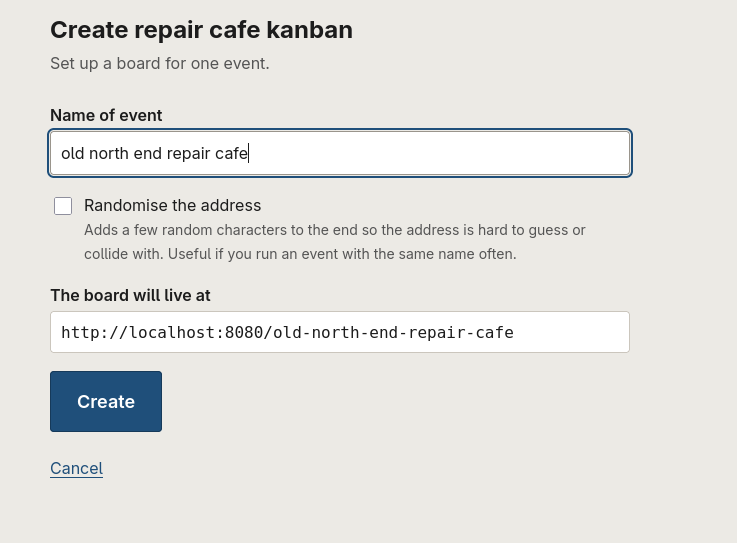
On the main page press Create repair cafe kanban and name the event. Tick randomise the address if you want a hard-to-guess URL.
-
You land on the sign-in form at
/<event-name>. Leave this open on a tablet or laptop by the door — it clears itself after every submission.
-
Open the kanban view/dashboard at
/<event-name>/dashboardon another laptop (and connect to big tv?) There is a link to it at the bottom of the sign-in form. -
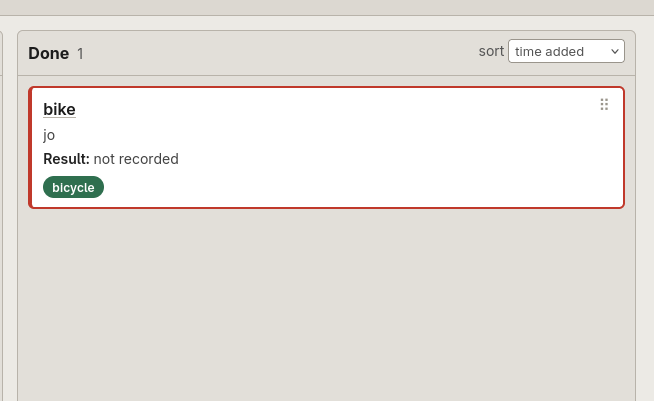
Drag cards between columns. Moving a card into In progress asks who is repairing it; moving it into Done asks how it went. A card that reaches Done without a result is outlined in red until someone fills it in.
-
Click any card's title to see and edit the full record, and to add notes.
-
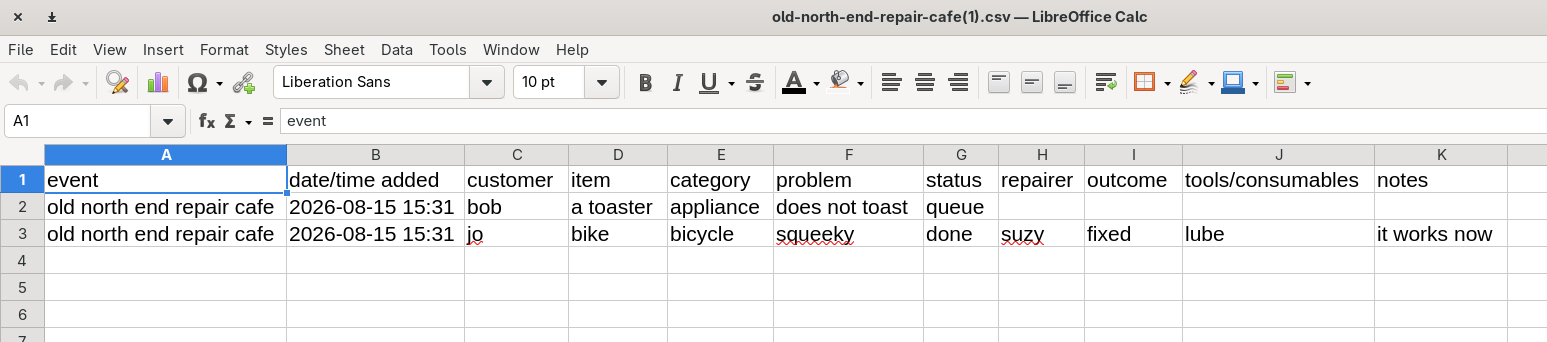
Press Download CSV at the end of the day.


On a touch screen, drag a card by its ⠿ grip in the top right corner — that leaves the rest of the card free for scrolling. You can also change a card's status from the detail overlay without dragging at all.
Configuration
Everything adjustable lives in config.json. Restart the server after editing it.
| Key | What it does |
|---|---|
port |
Port to listen on (the PORT environment variable wins). |
retentionDays |
Events are deleted this many days after creation. Set to 0 to keep them forever. |
categories |
The item categories offered on the sign-in form, each with the colour of its badge on the board. |
houseRules |
The text shown in the house rules popup. \n starts a new line. |
Adding a category is a config edit and a restart — no code change.
Where the data lives
One JSON file per event in data/, named after its URL. They are plain text, so
you can read, back up, or delete them by hand. data/expired.json remembers the
names of events that have been auto-deleted, so their URLs can say "expired"
instead of "not found".
Each event's CSV is linked from its own dashboard. There is also a combined CSV
of every event at /export.csv — it is not linked from anywhere, since it is
for the person running the server rather than for volunteers on the day.
Events are permanently deleted after retentionDays days (7 by default),
on startup and once a day after that. Download the CSV before then if you want
to keep the data.
Putting it on a real server
Copy the folder up and run node server.js. To keep it running, a systemd unit
is enough:
# /etc/systemd/system/repair-cafe.service
[Unit]
Description=Repair Cafe Kanban
After=network.target

[Service]
ExecStart=/usr/bin/node /srv/repair-cafe-kanban/server.js
WorkingDirectory=/srv/repair-cafe-kanban
Environment=HOST=127.0.0.1
Restart=always
User=www-data

[Install]
WantedBy=multi-user.target
Then put nginx in front of it for TLS and a real domain name:
server {
    server_name repair.example.org;
    location / {
        proxy_pass http://127.0.0.1:8080;
        proxy_set_header Host $host;
    }
}
There are no accounts and no passwords: anyone with a board's URL can view it, sign items in, and move cards. That is fine for a public repair cafe, but do not put anything on it you would not put on a whiteboard in the room.
Layout
server.js          HTTP server: routing, JSON API, CSV export, retention
config.json        categories, house rules, port, retention
lib/store.js       reading and writing events on disk
lib/csv.js         CSV formatting
public/            the pages, one stylesheet, two scripts
data/              one JSON file per event (created on first run, not in git)